
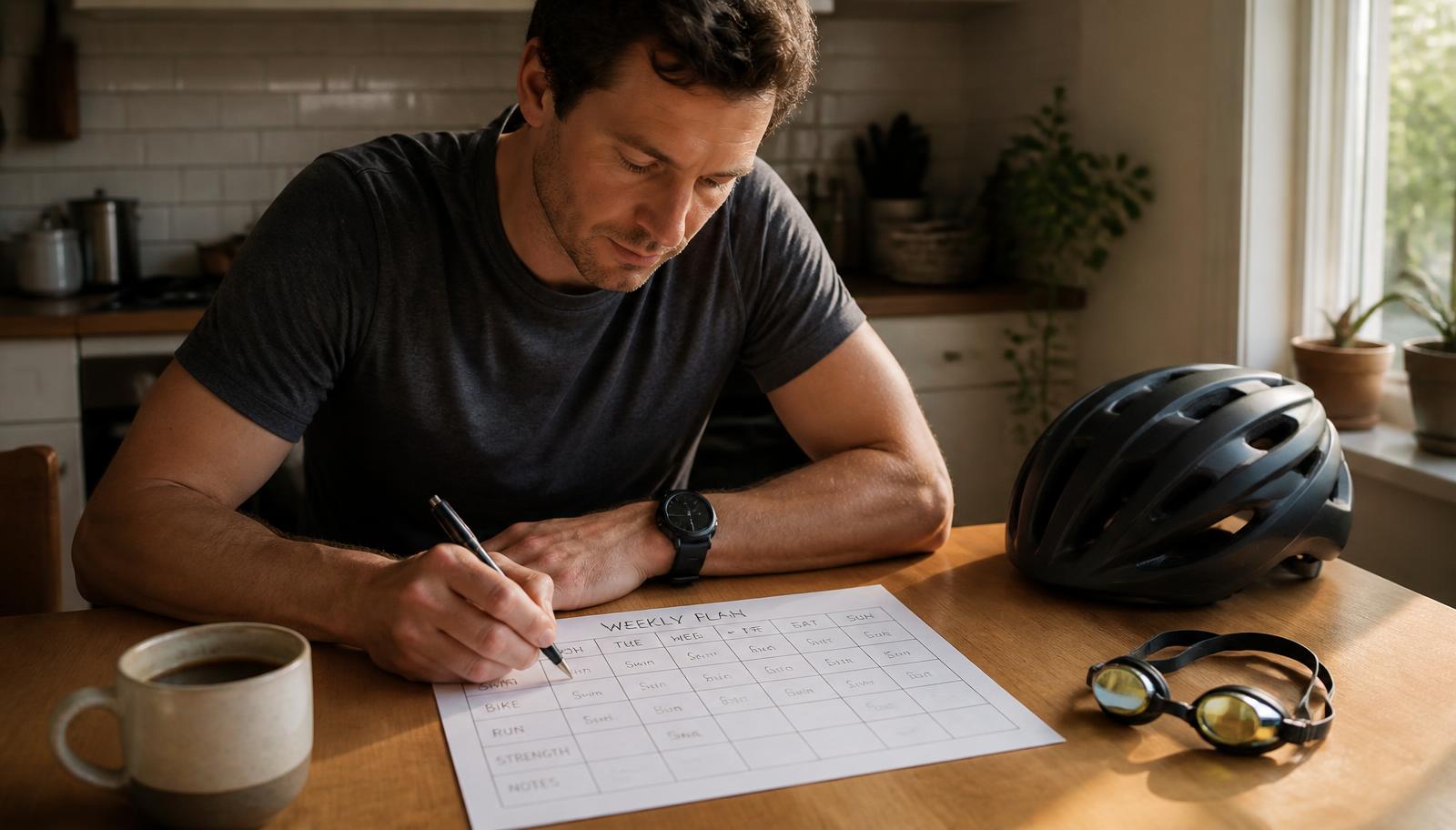
Weekly Volume Planner
Plan your swim, bike, run and rest sessions around the hours you actually have.
One of the biggest mistakes beginners make is thinking they need to train every day, or somehow find ten hours a week before they can enter a triathlon. For most people preparing for a Sprint or Olympic-distance event, that simply isn’t necessary.
The best training plan isn’t the one with the most hours. It’s the one you can consistently fit around your real life.
Start by deciding how much time you genuinely have available each week, and get the buy-in from your partner and family — you will definitely need this support. Be realistic: work, family, commuting and everything else still need to happen. If four hours is what you can manage, build a good four-hour week rather than planning six hours and regularly missing sessions.
Weekly Volume Planner
Plan your swim, bike, run and rest sessions around the hours you actually have.
5 hours per week
Choose the time you can consistently manage around work, family and everyday life.
What should your week include?
Triathlon has three disciplines, so you need regular exposure to swimming, cycling and running. You also need recovery.
For a beginner, a typical week might include two swims, two bike sessions and two runs. One of those runs can be a short brick run, where you run immediately after cycling. This teaches your legs what it feels like to change from cycling to running.
That doesn’t mean you need six separate training days. Combining a bike and short run allows you to cover both disciplines while still keeping rest days.

Four hours, six hours — what can you prepare for?
If you only have around four hours per week, you can still prepare for many Sprint triathlons. Your sessions simply need a clear purpose. A week might contain a technique-focused swim, a steady swim, a run, a bike with a short brick run, and another run or bike session.
With around six hours per week, you have more room to build endurance. Your longer bike and run can gradually increase, and you can spend more time developing your swimming technique without rushing.
For an Olympic-distance triathlon, six hours is a more comfortable starting point for many beginners, although your previous fitness and experience will make a difference.
Remember that indoor bike sessions can be shorter than outdoor rides and just as effective — and they can be done at any time, whether that’s a dark, cold winter evening or early morning before work. Working from home can be a bonus too, letting you fit in short training sessions at lunchtime without impacting anything else.
Example 4-hour Sprint week
- Monday — Rest
- Tuesday — Swim: 45 minutes, technique
- Wednesday — Run: 40 minutes, steady/easy
- Thursday — Rest or mobility
- Friday — Swim: 35 minutes, controlled endurance
- Saturday — Bike + Brick: 60-minute bike + 20-minute easy run
- Sunday — Run or Bike: 40 minutes, alternate the emphasis between weeks
Total: 4 hours
Example 6-hour week
- Monday — Rest
- Tuesday — Swim: 45 minutes, technique
- Wednesday — Run: 45 minutes, easy aerobic
- Thursday — Swim: 45 minutes, endurance
- Friday — Bike: 60 minutes, steady
- Saturday — Bike + Brick: 85-minute bike + 20-minute easy run
- Sunday — Run: 60 minutes, easy
Total: 6 hours

Don’t forget recovery
Rest isn’t wasted training time. Your body needs an opportunity to recover and adapt to the work you’ve done. Trying to squeeze hard sessions into every available day can leave you tired and more prone to injury, without making you fitter.
Your training volume should also increase gradually. You don’t need to suddenly double your weekly hours because race day is getting closer.
Use the Weekly Volume Planner above to start with the time you actually have, then divide it sensibly between swimming, cycling, running and recovery.
Don’t worry if your week occasionally changes — life can just get in the way. Move sessions around, shorten one if necessary and carry on. That is what keeps the consistency.
Consistency beats the perfect training plan. Four sensible hours completed every week are far more useful than six hours permanently written in a diary but rarely done.
Keep exploring
Read more about training on 4–6 hours a week, or head back to Free Tools for more practical training resources.